

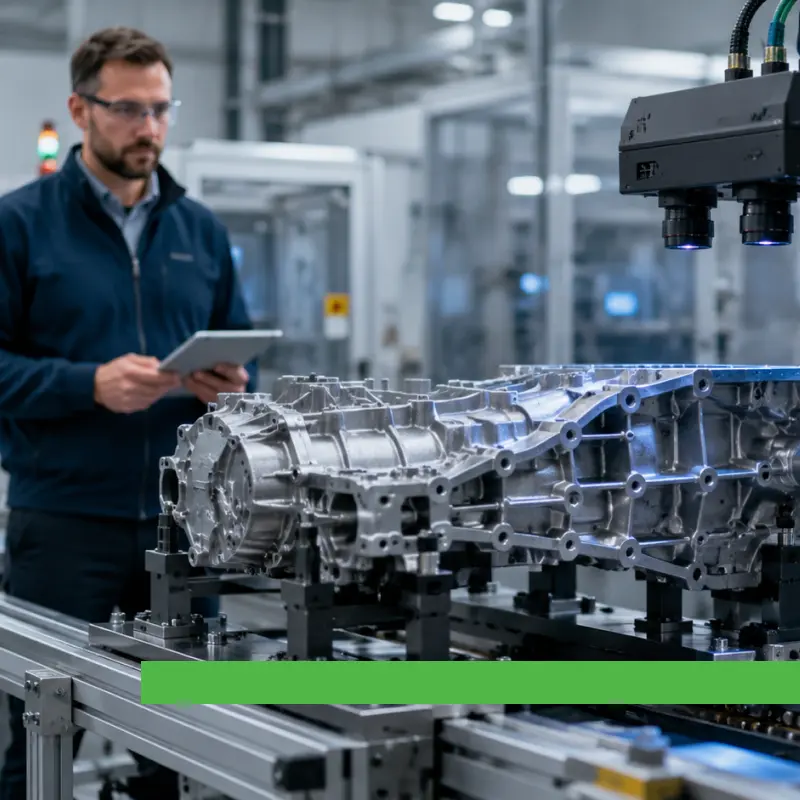
Scratches. Surface defects. Missing components. Incorrect positioning. Deformation. Colour deviations.
An experienced quality inspector can identify numerous irregularities that may indicate a potential quality issue.
However, another tool is rapidly gaining importance alongside human inspection:
AI-powered machine vision.
Two technology announcements made in August 2026 provide an interesting indication of where industrial quality inspection may be heading.
The key question, however, may not be:
AI or human?
A better question is:
Which tasks can each perform most effectively?
AI Is No Longer Limited to 2D Images
On 3 August 2026, SICK announced new AI-powered 3D machine vision capabilities for its Nova platform.
The solution combines deep learning with precise 3D height data analysis. According to SICK, this allows the system to use spatial information in addition to conventional image data during inspection.
The technology is positioned for industries including automotive manufacturing, battery production and electronics.
This capability can be particularly relevant when quality deviations involve:
- shape,
- height,
- geometry,
- position,
- or complex surface structures.
Automotive manufacturing contains many applications where precisely these characteristics matter.
When Machine Vision Becomes Connected to the QMS
On 11 August 2026, Rockwell Automation announced an API-enabled integration between Plex Quality Management System and FactoryTalk Analytics VisionAI.
The integration is designed to bring AI-powered visual inspection into quality management workflows and support areas such as defect detection and traceability.
From a quality perspective, this is significant.
A camera system no longer has to provide only a simple message:
“A defect has been detected.”
Inspection information can potentially be connected to:
which product was inspected, when the deviation occurred, where it occurred in the process and what type of defect was identified.
At that point, visual inspection becomes more than inspection.
It becomes structured quality data.
Why Can AI Be Effective in Visual Quality Inspection?
Traditional rule-based vision systems usually operate according to predefined criteria.
Some defects, however, are difficult to describe with simple rules.
A scratch, for example, can:
- appear in different locations,
- vary in length,
- occur at different angles,
- look different under changing lighting conditions,
- and represent different levels of quality risk.
One potential advantage of deep-learning approaches is their ability to recognise more complex patterns when trained with suitable data.
Will AI Replace the Quality Inspector?
Not necessarily.
A more likely scenario is that the division of work between people and technology will change.
AI and machine vision can be particularly effective for:
- repetitive inspection tasks,
- continuous monitoring,
- pattern comparison,
- processing large quantities of data,
- consistently searching for defined deviations.
Human inspectors, however, continue to offer essential capabilities.
They can understand context.
They can recognise unusual situations that have not been encountered before.
They can connect multiple observations.
And they can make decisions in situations for which an automated system may have insufficient training data or no predefined response.
The better question may therefore not be:
AI or human?
But:
AI and human – how should tasks be divided between them?
AI Detects an NOK Part. What Happens Next?
This is one of the most important quality questions.
Imagine an AI-powered camera identifies a deviation.
What happens next?
Does the production process stop?
Is the product automatically separated?
Who confirms whether the part is genuinely NOK?
Could the previous 10, 100 or 1,000 products also be affected?
Should containment begin?
Is 100% sorting required?
What is the root cause?
Should production parameters be adjusted?
Most of these questions are no longer image-recognition tasks.
They are quality-management decisions.
Technology Alone Is Not Quality Assurance
Even an advanced AI-powered vision system does not constitute a complete quality assurance process on its own.
Its real value emerges when it is connected to:
- clearly defined OK/NOK criteria,
- reaction plans,
- the QMS,
- traceability,
- manufacturing data,
- containment processes,
- and human decision-making.
Technology can identify a deviation.
The organisation still needs to know what to do with that information.
The Greatest Value May Be the Data
In the long term, the most valuable outcome of AI-powered inspection may not simply be faster NOK detection.
It may be the fact that every inspection can generate data.
When this information is connected with manufacturing data, previously hidden patterns may become visible.
For example:
a certain defect type begins appearing more frequently;
the NOK rate increases following a process-parameter change;
a specific supplier batch shows a different defect pattern;
a quality indicator gradually deteriorates during a particular production period.
Visual inspection can then evolve from a defect-detection tool into an important source of information for continuous process improvement.
The Human Role May Not Disappear – It May Evolve
Automation may increasingly support monotonous, repetitive inspection tasks.
At the same time, the role of the human quality professional may shift toward:
interpreting deviations, investigating complex problems, managing reactions and improving processes.
This is not only a technological development.
It may also represent an evolution of the quality inspector's role.
The Future of Quality Inspection Is Likely to Be Hybrid
SICK's AI-powered 3D machine vision development and Rockwell Automation's QMS–VisionAI integration both indicate that artificial intelligence is becoming more deeply connected to industrial quality processes.
AI's greatest value, however, may not be replacing people.
It may be providing quality professionals with tools that allow them to make decisions:
faster, more consistently and based on more data.
The competitive advantage of future quality assurance may therefore not be determined by who uses the most AI.
It may depend on who can best connect:
technology, data, processes and human expertise.
At Miell Quality, we believe that regardless of the technology used, the fundamental objective of automotive quality remains unchanged:
the conforming product should move forward – the non-conforming one should not.
Sources
SICK – AI-powered 3D Quality Inspection with Nova Machine Vision Platform, 3 August 2026.
Rockwell Automation – Rockwell Automation Integrates Plex QMS With FactoryTalk Analytics VisionAI to Advance AI-Driven Quality, 11 August 2026.